Children’s Stick Insect – Tropidoderus childrenii
© Mount Glorious Biological Centre
Description:
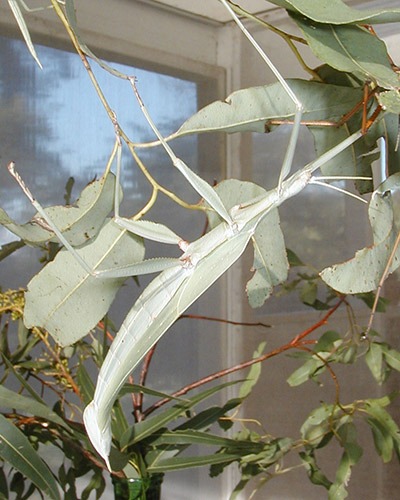
The Children’s Stick Insect or Yellow-winged Spectre is found throughout the Eastern Coast of Queensland, New South Wales and Victoria. Their bodies grow up to around 14cm in length, and both the males and females have two pairs of wings. The females are usually a beautiful apple-green colour, but can also be cream or very light pink or purple. Their wings are tinted yellow and have bright splashes of yellow and blue where they join to the body. The males look very different to the females. They are very slender and are a light reddish brown colour.
Life Cycle:
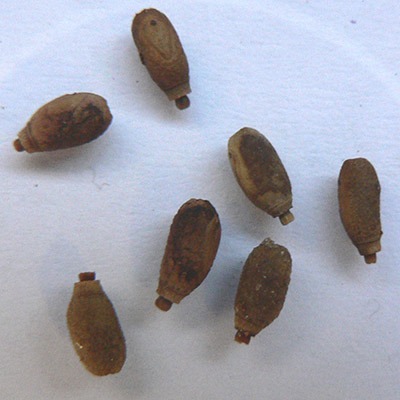
The males are strong fliers and will fly from tree to tree searching for females. They occasionally turn up around porch lights during the summer. The females are rather heavy bodied due to their massive load of eggs and as a result, cannot fly much at all. They remain high in the trees where they eat and lay eggs. The eggs laid by the female are small, oval and grey. They drop down into the leaf litter, where they wait to hatch.
After around 4 months, the eggs will hatch. The nymphs are light green in colour, but can also come in a pale pink/purple shade.
Favourite foods:
The Children’s Stick Insect likes to eat many different varieties of Eucalyptus (Gum trees).
Defence tactics:
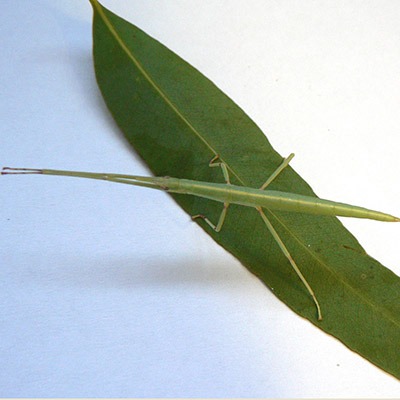
The Children’s Stick Insect is a master of camouflage and they are very hard to spot amongst the foliage of gum trees. The nymphs have a long yellow stripe that runs down the centre of their bodies, which exactly matches the shape and colour of the vein that runs down the centre of a gum leaf. The nymphs will position their bodies on the centre of the leaf, hold their legs close to their sides and flatten their bodies down onto the leaf. This makes them virtually disappear along the centre of the leaf. Children’s Stick Insects will also drop off one or more of their legs to escape a predator (much like a lizard losing its tail). They can also flash their wings revealing their bright yellow and blue markings.
Fascinating Facts:
- The Children’s Stick Insect looks so much like a leaf that it even fools other stick insects! In crowded situations, a stick insect will sometimes start nibbling on the wings of a Children’s Stick insect thinking that it is actually a gum leaf! As stick insects don’t have a lot of feeling in their wings, it will sit there unaware that it is being chewed on! It is quite common to find stick insects that have been reared in a cage with large “shark bites” out of their wings!